Foodservice DistributionTX-A78F
Sysco Holds Annual Forecast as Economic Uncertainty Weighs on Foodservice
Sysco, North America's largest foodservice distributor, reaffirmed its annual forecast despite economic uncertainty, signaling management still expects volume and margin to hold across its restaurant base.
- Scan date
- September 30, 2026
- Handle time
- 3 min
- Ticket
- TX-A78F
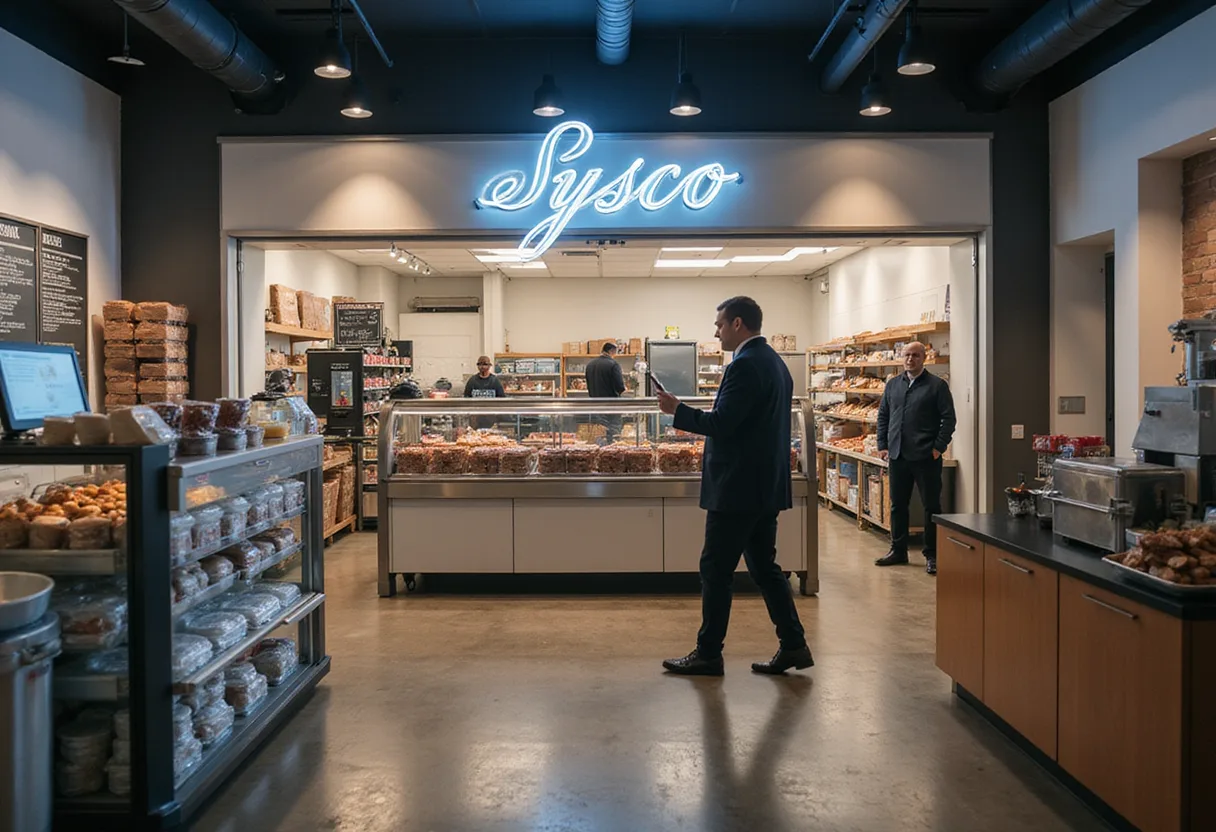
Packing list
Sysco kept its annual forecast intact, according to Reuters.
The reaffirmation comes amid broad economic uncertainty affecting its foodservice customer base.
The forecast reflects management's confidence in demand; actual sales and margin results remain to be disclosed.
Sysco, the largest foodservice distributor in North America, has kept its annual forecast intact even as economic uncertainty looms over the restaurant and hospitality channels it serves.
The decision to stand by guidance is the concrete move here. For a broadline distributor of Sysco's scale, an annual forecast is not a soft aspiration — it is a working assumption baked into purchasing commitments with suppliers, capacity plans at distribution centers and staffing levels across delivery routes. Holding it signals that Sysco's read of current demand has not deteriorated enough to force a revision.
The backdrop explains why the market was watching. Economic uncertainty — the phrase Reuters uses — covers the familiar pressures on foodservice distribution: consumers pulling back on dining out, cost inflation squeezing restaurant operators, and macro volatility that makes volume planning harder across both independent restaurants and national chains. Sysco's customer base spans exactly those segments, so its guidance is a proxy for the health of eating-out demand in its core geographies.
What is measured, and what is asserted, deserve separation. The measured fact is the forecast itself: Sysco reaffirmed its full-year outlook rather than cutting or raising it. That is a disclosed, verifiable corporate action. What remains asserted rather than demonstrated in the source material is the depth of the economic uncertainty and how it will actually translate into case volume, gross margin or inventory turns in coming quarters. A held forecast tells investors management still expects its plan to hold; it does not yet prove the plan will.
For distribution economics, the stakes are straightforward. In foodservice broadline, gross margin depends on product cost pass-through, mix between higher-margin independent accounts and lower-margin chain business, and the discipline of pricing in an inflationary cycle. Volume stability matters just as much: fixed costs in warehousing and fleet are high, so flat or declining case growth compresses operating leverage quickly. A reaffirmed forecast implies Sysco still expects the volume and margin balance it originally modeled — a non-trivial stance when restaurant traffic indicators across the industry have been uneven.
The channel-power dimension matters too. Sysco's scale gives it purchasing leverage with suppliers that smaller regional distributors lack, and in uncertain demand environments that leverage typically widens the cost gap between the largest players and the rest of the channel. If macro pressure does intensify, the likely result across foodservice distribution is share consolidation toward scaled broadliners rather than uniform pain — a dynamic consistent with Sysco's willingness to keep its outlook unchanged.
Investors and channel watchers will now test the forecast against actual disclosures in coming quarters: sales growth, gross margin performance and any commentary on case volume trends in the U.S. foodservice unit, which drives the bulk of results. Until those numbers arrive, the reaffirmation stands as management's stated confidence — data to be interrogated, not yet confirmed.
Going forward, the forecast's survival will depend on whether consumer spending on foodservice holds up as economic uncertainty plays out, and any revision in either direction will be an early, hard signal of where restaurant demand — and distributor economics across the channel — are heading next.
via Google News: Foodservice distribution (Source)
More from Priya Raman
Show full bio
Correspondent covering technology and product news in Wholesale and distribution industry coverage for B2B professionals at Distribution Brief.
126 articles